
A Name Rooted in Place
Centennial Hills is a neighborhood name that captures two things residents notice immediately: the community’s connection to the City of Centennial and the gently rolling terrain that gives this part of Arapahoe County its open, spacious character. Unlike some older Colorado neighborhoods with sharply defined historic boundaries, “Centennial Hills” is best understood as a local, descriptive name for a residential area within the broader City of Centennial rather than as a separately incorporated town or formally established municipality.
That distinction is part of the neighborhood’s story. Centennial itself is a young city, officially established on February 7, 2001, but the land beneath today’s homes, schools, parks, and roads has a much longer history. The name Centennial honors Colorado’s longtime nickname, the “Centennial State,” while “Hills” reflects the area’s broad ridges, shallow valleys, drainage corridors, and views toward the Front Range.
For longtime residents, the name feels natural. It describes not only geography, but also a community that grew during the period when southeastern metro Denver changed from a semi-rural edge into a collection of established neighborhoods.
Before the Houses: Farms, Open Land, and Early Roads
Before subdivision signs and landscaped entrances appeared, much of the Centennial area consisted of farms, ranches, pasture, and undeveloped prairie. Water shaped the landscape. Dry Creek, Little Dry Creek, the High Line Canal, and nearby drainageways helped define where people settled and how roads were laid out.
The High Line Canal is especially important to understanding the area’s heritage. Constructed in the late nineteenth century to carry irrigation water south from the South Platte River, the canal supported agriculture and helped transform dry prairie into productive farmland. Today, portions of the canal corridor serve as a treasured recreational trail, but its original purpose remains visible in the mature cottonwoods, gently winding alignment, and green ribbon that contrasts with the surrounding development.
Roads such as Arapahoe Road, University Boulevard, Parker Road, and Yosemite Street also tell the story of change. Some began as rural routes connecting farms and small settlements. Over time, they became major transportation corridors linking Centennial with Denver, Aurora, Greenwood Village, Parker, and the Denver Tech Center.
The Arrival of Suburbia
The neighborhood landscape began changing rapidly in the second half of the twentieth century. As the Denver metropolitan area expanded southward, former agricultural parcels were gradually divided into residential developments. Ranch-style homes, split-level houses, cul-de-sacs, townhomes, and apartment communities appeared alongside remnants of open land.
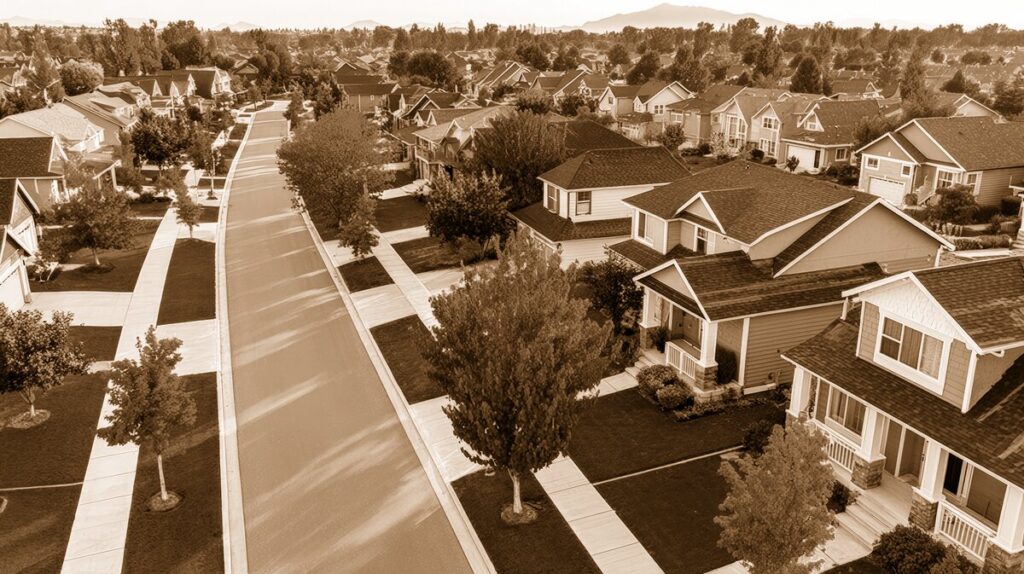
Many of the homes associated with the Centennial Hills area date from the late 1970s through the early 2000s. Their architecture reflects the evolution of suburban Colorado: early brick ranches and tri-levels gave way to larger two-story houses, planned communities, and newer developments with connected sidewalks and shared greenbelts.
This period also brought schools, shopping centers, churches, recreation facilities, and improved roads. What had once been a quiet edge of the metro area became a practical place for families seeking larger lots, strong schools, access to employment, and a short drive to the mountains.
Centennial Becomes a City
The most important civic milestone in the area’s modern history came in the late 1990s. Residents living in unincorporated Arapahoe County organized around the idea of forming a new city. They wanted greater local control over taxes, services, planning, and community priorities.
In 1998, the Arapahoe Citizens for Self-Determination began the incorporation effort. After a legal challenge and a successful petition drive, voters considered the proposal on September 12, 2000. Seventy-seven percent approved the formation of the City of Centennial. The new city officially began operating on February 7, 2001, with Randy Pye serving as its first mayor. ([centennialco.gov](https://www.centennialco.gov/Government/About-Us/History?lang_update=639156359683107644&utm_source=openai))
That decision gave the Centennial Hills area a stronger civic identity. Neighborhoods that had previously been described mainly by subdivisions, school boundaries, or mailing addresses were now part of a city with its own vision and public institutions.
Parks and Open Spaces as Local Landmarks
For many residents, the most meaningful landmarks are not historic buildings but parks, trails, and preserved landscapes. Centennial has developed an extensive network of parks and open spaces, including more than 100 parks, approximately 100 miles of trails, and thousands of acres of open space. ([centennialco.gov](https://www.centennialco.gov/Government/Departments/Parks-Trails-Open-Spaces?utm_source=openai))
Centennial Center Park, adjacent to the Centennial Civic Center near East Arapahoe Road, represents the city’s effort to create a shared civic heart. The city purchased the Civic Center property and adjacent open space in 2008, later developing the park as a gathering place for concerts, celebrations, festivals, and everyday recreation. ([centennialco.gov](https://www.centennialco.gov/Government/About-Us/History?utm_source=openai))
Other nearby landmarks help define the area’s sense of place:
- The High Line Canal Trail, valued for walking, cycling, shade trees, and historic character.
- DeKoevend Park, a popular regional destination near the South Suburban Recreation Center.
- Cherry Creek State Park, whose reservoir, trails, and open prairie provide a major recreational resource nearby.
- Willow Creek Park, Fox Hill Park, Holly Park and Open Space, and Piney Creek Hollow Park, which connect residential areas with broader trail and drainage systems.
- Fiddler’s Green Amphitheatre, near the western side of Centennial, which has become a recognizable cultural and entertainment landmark.
These places show how the neighborhood evolved from an agricultural landscape into a community where open space remains central to daily life.
Schools, Shopping, and Community Memory
Institutions have played a major role in making Centennial Hills feel established. Local schools, libraries, recreation centers, houses of worship, and youth sports programs helped turn subdivisions into neighborhoods. Generations of children have grown up walking or biking along neighborhood streets, attending nearby schools, and meeting friends at parks.
Commercial landmarks have changed as well. The former Southglenn Mall, near South University Boulevard and East Arapahoe Road, was redeveloped into The Streets at SouthGlenn beginning in the mid-2000s. Its transformation reflects a broader shift from enclosed suburban malls to mixed-use districts with restaurants, offices, apartments, shops, public gathering spaces, and outdoor events. ([en.wikipedia.org](https://en.wikipedia.org/wiki/The_Streets_at_SouthGlenn?utm_source=openai))
Meanwhile, the Denver Tech Center and nearby business corridors brought employment and investment. Roads once used primarily for local travel became busy commuter routes, and the neighborhood gained easier access to light rail, offices, medical services, and regional shopping.
A Neighborhood Still Evolving
Centennial Hills today is not frozen in one decade. Mature trees and established homes stand beside new construction. Older shopping areas are being reinvigorated, while projects such as Midtown Centennial envision more walkable streets, parks, housing, and connections near the Dry Creek Light Rail Station. ([centennialco.gov](https://www.centennialco.gov/Government/City-Projects-and-Initiatives/Midtown-Centennial?utm_source=openai))
That blend of old and new is what makes the area appealing. Residents can enjoy modern conveniences while still finding traces of the earlier landscape in canal paths, open fields, cottonwood stands, drainage corridors, and long views across the prairie.
The neighborhood’s heritage is therefore less about one famous building or a single founding date. It is a layered story: Indigenous and agricultural landscapes, rural roads, postwar suburban growth, determined residents, and a young city learning how to preserve its character while accommodating change.
For those who call Centennial Hills home, the special quality lies in that balance. It is a place shaped by growth, but not entirely defined by it—a neighborhood where the past remains visible in the land and the future is still being built one park, street, school, and front porch at a time.